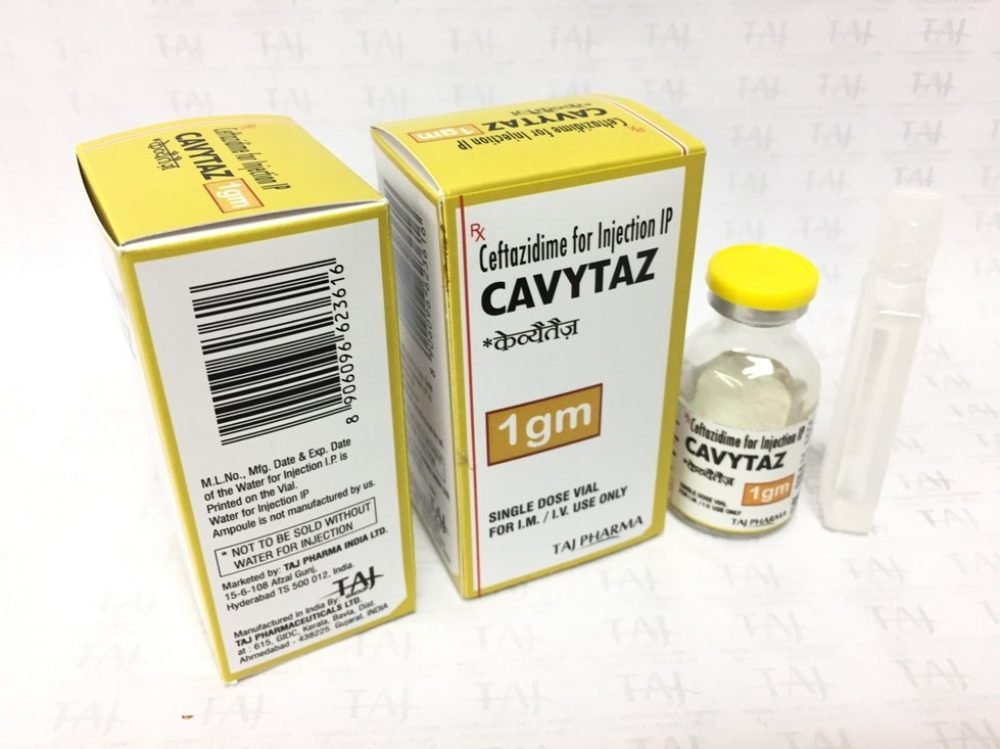
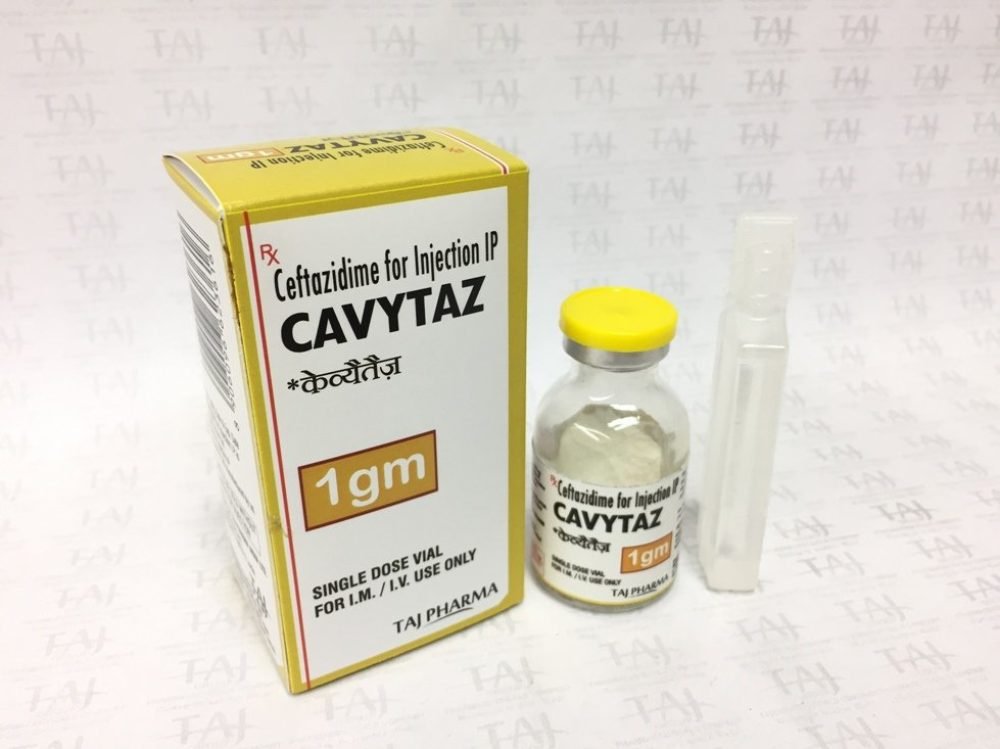
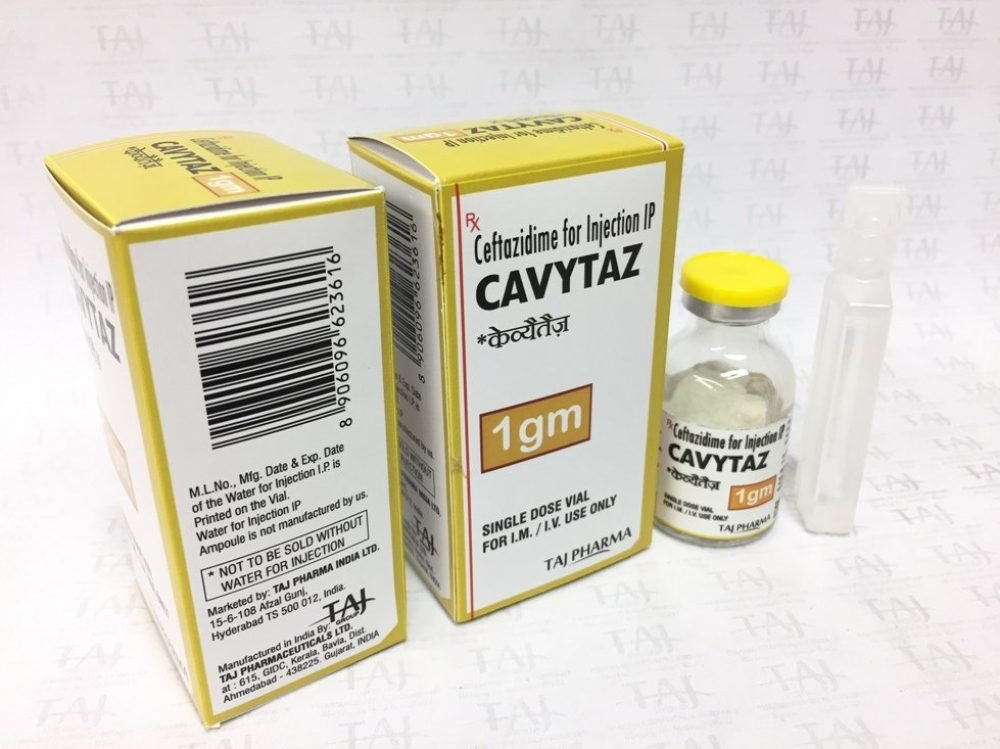
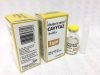
- Name of the medicinal product
Ceftazidime for Injection IP 1g (CAVYTAZ) Taj Pharma
- Qualitative and quantitative composition
Each vial contains 1g Ceftazidime (as pentahydrate)
Also contains sodium carbonate anhydrous (equivalent to 52mg sodium)
For a full list of excipients, see section 6.1.
- Pharmaceutical form
Powder for solution for injection
A white to cream-coloured powder.
- Clinical particulars
4.1 Therapeutic indications
Ceftazidime is indicated for the treatment of the infections listed below in adults and children including neonates (from birth).
- Nosocomial pneumonia
- Broncho-pulmonary infections in cystic fibrosis
- Bacterial meningitis
- Chronic suppurative otitis media
- Malignant otitis externa
- Complicated urinary tract infections
- Complicated skin and soft tissue infections
- Complicated intra-abdominal infections
- Bone and joint infections
- Peritonitis associated with dialysis in patients on CAPD.
Treatment of patients with bacteraemia that occurs in association with, or is suspected to be associated with, any of the infections listed above.
Ceftazidime may be used in the management of neutropenic patients with fever that is suspected to be due to a bacterial infection.
Ceftazidime may be used in the peri-operative prophylaxis of urinary tract infections for patients undergoing trans-urethral resection of the prostate (TURP).
The selection of ceftazidime should take into account its antibacterial spectrum, which is mainly restricted to aerobic Gram negative bacteria (see sections 4.4 and 5.1).
Ceftazidime should be co-administered with other antibacterial agents whenever the possible range of causative bacteria would not fall within its spectrum of activity.
Consideration should be given to official guidelines on the appropriate use of antibacterial agents.
4.2 Posology and method of administration
Posology
Table 1: Adults and children ≥ 40 kg
| Intermittent Administration | |
| Infection | Dose to be administered |
| Broncho-pulmonary infections in cystic fibrosis | 100 to 150 mg/kg/day every 8 h, maximum 9 g per day1 |
| Febrile neutropenia | 2 g every 8 h |
| Nosocomial pneumonia | |
| Bacterial meningitis | |
| Bacteraemia* | |
| Bone and joint infections | 1-2 g every 8 h |
| Complicated skin and soft tissue infections | |
| Complicated intra-abdominal infections | |
| Peritonitis associated with dialysis in patients on CAPD | |
| Complicated urinary tract infections | 1-2 g every 8 h or 12 h |
| Peri-operative prophylaxis for transuretheral resection of prostate (TURP) | 1 g at induction of anaesthesia, and a second dose at catheter removal |
| Chronic suppurative otitis media | 1 g to 2 g every 8h |
| Malignant otitis externa | |
| Continuous infusion | |
| Infection | Dose to be administered |
| Febrile neutropenia | Loading dose of 2 g followed by a continuous infusion of 4 to 6 g every 24 h1 |
| Nosocomial pneumonia | |
| Broncho-pulmonary infections in cystic fibrosis | |
| Bacterial meningitis | |
| Bacteraemia* | |
| Bone and joint infections | |
| Complicated skin and soft tissue infections | |
| Complicated intra-abdominal infections | |
| Peritonitis associated with dialysis in patients on CAPD | |
| 1 In adults with normal renal function 9 g/day has been used without adverse effects.
* When associated with, or suspected to be associated with, any of the infections listed in section 4.1. |
|
Table 2: Children < 40 kg
| Infants and toddlers > 2 months and children < 40 kg | Infection | Usual dose |
| Intermittent Administration | ||
| Complicated urinary tract infections | 100-150 mg/kg/day in three divided doses, maximum 6 g/day | |
| Chronic suppurative otitis media | ||
| Malignant otitis externa | ||
| Neutropenic children | 150 mg/kg/day in three divided doses, maximum 6 g/day | |
| Broncho-pulmonary infections in cystic fibrosis | ||
| Bacterial meningitis | ||
| Bacteraemia* | ||
| Bone and joint infections | 100-150 mg/kg/day in three divided doses, maximum 6 g/day | |
| Complicated skin and soft tissue infections | ||
| Complicated intra-abdominal infections | ||
| Peritonitis associated with dialysis in patients on CAPD | ||
| Continuous infusion | ||
| Febrile neutropenia | Loading dose of 60-100 mg/kg followed by a continuous infusion 100-200 mg/kg/day, maximum 6 g/day | |
| Nosocomial pneumonia | ||
| Broncho-pulmonary infections in cystic fibrosis | ||
| Bacterial meningitis | ||
| Bacteraemia* | ||
| Bone and joint infections | ||
| Complicated skin and soft tissue infections | ||
| Complicated intra-abdominal infections | ||
| Peritonitis associated with dialysis in patients on CAPD | ||
| Neonates and infants ≤ 2 months | Infection | Usual dose |
| Intermittent Administration | ||
| Most infections | 25-60 mg/kg/day in two divided doses1 | |
| 1 In neonates and infants ≤ 2 months, the serum half life of ceftazidime can be three to four times that in adults.
* Where associated with, or suspected to be associated with, any of the infections listed in section 4.1. |
||
Paediatric population
The safety and efficacy of Ceftazidime administered as continuous infusion to neonates and infants ≤ 2 months has not been established.
Elderly
In view of the age related reduced clearance of ceftazidime in elderly patients, the daily dose should not normally exceed 3 g in those over 80 years of age.
Hepatic impairment
Available data do not indicate the need for dose adjustment in mild or moderate liver function impairment. There are no study data in patients with severe hepatic impairment (see also section 5.2). Close clinical monitoring for safety and efficacy is advised.
Renal impairment
Ceftazidime is excreted unchanged by the kidneys. Therefore, in patients with impaired renal function, the dosage should be reduced (see also section 4.4).
An initial loading dose of 1 g should be given. Maintenance doses should be based on creatinine clearance:
Table 3: Recommended maintenance doses of Ceftazidime in renal impairment – intermittent infusion
Adults and children ≥ 40 kg
| Creatinine clearance
(ml/min) |
Approx. serum creatinine
μmol/l (mg/dl) |
Recommended unit dose of ceftazidime (g) | Frequency of dosing
(hourly) |
| 50-31 | 150-200 (1.7-2.3) | 1 | 12 |
| 30-16 | 200-350 (2.3-4.0) | 1 | 24 |
| 15-6 | 350-500 (4.0-5.6) | 0.5 | 24 |
| <5 | >500 (>5.6) | 0.5 | 48 |
In patients with severe infections the unit dose should be increased by 50% or the dosing frequency increased.
In children the creatinine clearance should be adjusted for body surface area or lean body mass.
Children < 40 kg
| Creatinine clearance
(ml/min)** |
Approx. serum creatinine
μmol/l (mg/dl) |
Recommended individual dose mg/kg body weight | Frequency of dosing
(hourly) |
| 50-31 | 150-200 (1.7-2.3) | 25 | 12 |
| 30-16 | 200-350 (2.3-4.0) | 25 | 24 |
| 15-6 | 350-500 (4.0-5.6) | 12.5 | 24 |
| <5 | >500 (>5.6) | 12.5 | 48 |
| * The serum creatinine values are guideline values that may not indicate exactly the same degree of reduction for all patients with reduced renal function
** Estimated based on body surface area, or measured. |
|||
Close clinical monitoring for safety and efficacy is advised.
Table 4: Recommended maintenance doses of Ceftazidime in renal impairment – continuous infusion
Adults and children ≥ 40 kg
| Creatinine clearance
(ml/min)** |
Approx. serum creatinine
μmol/l (mg/dl) |
Frequency of dosing
(hourly) |
| 50 – 31 | 150-200 (1.7-2.3) | Loading dose of 2g followed by 1g to 3g/24 hours |
| 30 – 16 | 200-350 (2.3-4.0) | Loading dose of 2g followed by 1g /24 hours |
| ≤ 15 | > 350 (>4.0) | Not evaluated |
Caution is advised in dose selection. Close clinical monitoring for safety and efficacy is advised.
Children < 40 kg
The safety and effectiveness of Ceftazidime administered as continuous infusion in renally impaired children < 40 kg has not been established. Close clinical monitoring for safety and efficacy is advised.
If continuous infusion is used in children with renal impairment, the creatinine clearance should be adjusted for body surface area or lean body mass.
Haemodialysis
The serum half-life during haemodialysis ranges from 3 to 5 h.
Following each haemodialysis period, the maintenance dose of ceftazidime recommended in the below table should be repeated.
Peritoneal dialysis
Ceftazidime may be used in peritoneal dialysis and continuous ambulatory peritoneal dialysis (CAPD).
In addition to intravenous use, ceftazidime can be incorporated into the dialysis fluid (usually 125 to 250 mg for 2 litres of dialysis solution).
For patients in renal failure on continuous arterio-venous haemodialysis or high-flux haemofiltration in intensive therapy units: 1 g daily either as a single dose or in divided doses. For low-flux haemofiltration, follow the dose recommended under renal impairment.
For patients on veno-venous haemofiltration and veno-venous haemodialysis, follow the dosage recommendations in the tables below.
Table 5: Continuous veno-venous haemofiltration dose guidelines
| Residual renal function (creatinine clearance ml/min) | Maintenance dose (mg) for an ultrafiltration rate (ml/min) of 1: | |||
| 5 | 16.7 | 33.3 | 50 | |
| 0 | 250 | 250 | 500 | 500 |
| 5 | 250 | 250 | 500 | 500 |
| 10 | 250 | 500 | 500 | 750 |
| 15 | 250 | 500 | 500 | 750 |
| 20 | 500 | 500 | 500 | 750 |
| 1 Maintenance dose to be administered every 12h | ||||
Table 6: Continuous veno-venous haemodialysis dose guidelines
| Residual renal function (creatinine clearance ml/min) | Maintenance dose (mg) for a dialysate in flow rate of 1 | |||||
| 1.0 litre/h | 2.0 litre/h | |||||
| Ultrafiltration rate (litres/h) | Ultrafiltration rate (litres/h) | |||||
| 0.5 | 1.0 | 2.0 | 0.5 | 1.0 | 2.0 | |
| 0 | 500 | 500 | 500 | 500 | 500 | 750 |
| 5 | 500 | 500 | 750 | 500 | 500 | 750 |
| 10 | 500 | 500 | 750 | 500 | 750 | 1000 |
| 15 | 500 | 750 | 750 | 750 | 750 | 1000 |
| 20 | 750 | 750 | 1000 | 750 | 750 | 1000 |
| 1 Maintenance dose to be administered every 12h | ||||||
Method of administration
Ceftazidime should be administered by intravenous injection or infusion, or by deep intramuscular injection. Recommended intramuscular injection sites are the upper outer quadrant of the gluteus maximus or lateral part of the thigh. Ceftazidime solutions may be given directly into the vein or introduced into the tubing of a giving set if the patient is receiving parenteral fluids.
The standard recommended route of administration is by intravenous intermittent injection or intravenous continuous infusion. Intramuscular administration should only be considered when the intravenous route is not possible or less appropriate for the patient.
The dose depends on the severity, susceptibility, site and type of infection and on the age and renal function of the patient.
For instructions on dilution of the product before administration, see section 6.6.
4.3 Contraindications
Hypersensitivity to ceftazidime, to any other cephalosporin or to any of the excipients. .
History of severe hypersensitivity (e.g. anaphylactic reaction) to any other type of beta-lactam antibacterial agent (penicillins, monobactams and carbapenems).
4.4 Special warnings and precautions for use
As with all beta-lactam antibacterial agents, serious and occasionally fatal hypersensitivity reactions have been reported. In case of severe hypersensitivity reactions, treatment with ceftazidime must be discontinued immediately and adequate emergency measures must be initiated.
Before beginning treatment, it should be established whether the patient has a history of severe hypersensitivity reactions to ceftazidime, to other cephalosporins or to any other type of beta-lactam agent. Caution should be used if ceftazidime is given to patients with a history of non-severe hypersensitivity to other beta-lactam agents
Ceftazidime has a limited spectrum of antibacterial activity. It is not suitable for use as a single agent for the treatment of some types of infections unless the pathogen is already documented and known to be susceptible or there is a very high suspicion that the most likely pathogen(s) would be suitable for treatment with ceftazidime. This particularly applies when considering the treatment of patients with bacteraemia and when treating bacterial meningitis, skin and soft tissue infections and bone and joint infections. In addition, ceftazidime is susceptible to hydrolysis by several of the extended spectrum beta lactamases (ESBLs). Therefore information on the prevalence of ESBL producing organisms should be taken into account when selecting ceftazidime for treatment.
Antibacterial agent-associated colitis and pseudo-membranous colitis have been reported with nearly all anti-bacterial agents, including ceftazidime, and may range in severity from mild to life-threatening. Therefore, it is important to consider this diagnosis in patients who present with diarrhoea during or subsequent to the administration of ceftazidime (see section 4.8). Discontinuation of therapy with ceftazidime and the administration of specific treatment for Clostridium difficile should be considered. Medicinal products that inhibit peristalsis should not be given.
Concurrent treatment with high doses of cephalosporins and nephrotoxic medicinal products such as aminoglycosides or potent diuretics (e.g. furosemide) may adversely affect renal function.
Ceftazidime is eliminated via the kidneys, therefore the dose should be reduced according to the degree of renal impairment. Patients with renal impairment should be closely monitored for both safety and efficacy. Neurological sequelae have occasionally been reported when the dose has not been reduced in patients with renal impairment (see sections 4.2 and 4.8).
Prolonged use of ceftazidime may result in the overgrowth of non-susceptible organisms (e.g. Enterococci, fungi.) which may require interruption of treatment or other appropriate measures. Repeated evaluation of the patient’s condition is essential.
Ceftazidime does not interfere with enzyme-based tests for glycosuria, but slight interference (false positive) may occur with copper reduction methods (Benedict’s, Fehling’s, Clinitest).
Ceftazidime does not interfere in the alkaline picrate assay for creatinine.
The development of a positive Coombs’ test associated with the use of ceftazidime in about 5% of patients may interfere with the cross-matching of blood.
Ceftazidime 1g powder for solution for injection contains 52 mg of sodium per vial. This should be considered for patients who are on a controlled sodium diet.
4.5 Interaction with other medicinal products and other forms of interaction
Interaction studies have only been conducted with probenecid and furosemide.
Concurrent use of high doses with nephrotoxic medicinal products may adversely affect renal function (see section 4.4).
Chloramphenicol is antagonistic in vitro with ceftazidime and other cephalosporins. The clinical relevance of this finding is unknown but if concurrent administration of ceftazidime with chloramphenicol is proposed, the possibility of antagonism should be considered.
4.6 Fertility, pregnancy and lactation
Pregnancy:
There are limited amounts of data from the use of ceftazidime in pregnant women. Animal studies do not indicate direct or indirect harmful effects with respect to pregnancy, embryonal/foetal development, parturition or postnatal development (see section 5.3).
Ceftazidime should be prescribed to pregnant women only if the benefit outweighs the risk.
Breast-feeding:
Ceftazidime is excreted in human milk in small quantities but at therapeutic doses of ceftazidime no effects on the breast-fed infant are anticipated. Ceftazidime can be used during breast-feeding.
Fertility
No data are available.
4.7 Effects on ability to drive and use machines
No studies on the effects on the ability to drive and use machines have been performed. However, undesirable effects may occur (e.g. dizziness), which may influence the ability to drive and use machines (see section 4.8)..
4.8 Undesirable effects
The most common adverse reactions are eosinophilia, thrombocytosis, phlebitis or thrombophlebitis with intravenous administration, diarrhoea, transient increases in hepatic enzymes, maculopapular or urticarcial rash, pain and/or inflammation following intramuscular injection and positive Coomb’s test.
Data from sponsored and un-sponsored clinical trials have been used to determine the frequency of common and uncommon undesirable effects. The frequencies assigned to all other undesirable effects were mainly determined using post-marketing data and refer to a reporting rate rather than a true frequency. Within each frequency grouping, undesirable effects are presented in order of decreasing seriousness. The following convention has been used for the classification of frequency:
Very common (≥1/10)
Common (≥1/100 to <1/10)
Uncommon (≥1/1,000 to <1/100)
Rare (≥1/10,000 to <1/1,000)
Very rare (<1/10,000)
Unknown (cannot be estimated from the available data)
| System Organ Class | Common | Uncommon | Very rare | Unknown |
| Infections and infestations | Candidiasis (including vaginitis and oral thrush) | |||
| Blood and lymphatic system disorders | Eosinophilia
Thrombocytosis |
Neutropenia
Leucopenia Thrombocytopenia |
Agranulocytosis
Haemolytic anaemia Lymphocytosis |
|
| Immune system disorders | Anaphylaxis (including bronchospasm and/or hypotension) (see section 4.4) | |||
| Nervous system disorders | Headache
Dizziness |
Neurological sequelae1.
Paraesthesia |
||
| Vascular disorders | Phlebitis or thrombophlebitis with intravenous administration | |||
| Gastrointestinal disorders | Diarrhoea | Antibacterial agent-associated diarrhoea and colitis2 (see section 4.4)
Abdominal pain Nausea Vomiting |
Bad taste | |
| Hepatobiliary disorders | Transient elevations in one or more hepatic enzymes3. | Jaundice | ||
| Skin and subcutaneous tissue disorders | Maculopapular or urticarial rash | Pruritus | Toxic epidermal necrolysis
Stevens-johnson syndrome Erythema multiforme Angioedema |
|
| Renal and urinary disorders | Transient elevations of blood urea, blood urea nitrogen and/or serum creatinine | Interstitial nephritis
Acute renal failure |
||
| General disorders and administration site conditions | Pain and/or inflammation after intramuscular injection | Fever | ||
| Investigations | Positive Coombs’ test4. |
- There have been reports of neurological sequelae including tremor, myoclonia, convulsions, encephalopathy, and coma in patients with renal impairment in whom the dose of ceftazidime has not been appropriately reduced.
- Diarrhoea and colitis may be associated with Clostridium difficile and may present as pseudomembranous colitis.
- ALT (SGPT), AST (SOGT), LHD, GGT, alkaline phosphatase.
- A positive Coombs test develops in about 5% of patients and may interfere with blood cross matching.
Reporting of suspected adverse reactions
Reporting suspected adverse reactions after authorisation of the medicinal product is important. It allows continued monitoring of the benefit/risk balance of the medicinal product.
4.9 Overdose
Overdosage can lead to neurological sequelae including encephalopathy, convulsions and coma.
Symptoms of overdose can occur if the dose is not reduced appropriately in patients with renal impairment (see sections 4.2 and 4.4).
Serum levels of ceftazidime can be reduced by haemodialysis or peritoneal dialysis.
- Pharmacological properties
5.1 Pharmacodynamic properties
Pharmacotherapeutic group: Antibacterials for systemic use. Third-generation cephalosporins.
Mechanism of action
Ceftazidime inhibits bacterial cell wall synthesis following attachment to penicillin binding proteins (PBPs). This results in the interruption of cell wall (peptidoglycan) biosynthesis, which leads to bacterial cell lysis and death.
PK/PD relationship
For cephalosporins, the most important pharmacokinetic-pharmacodynamic index correlating with in vivo efficacy has been shown to be the percentage of the dosing interval that the unbound concentration remains above the minimum inhibitory concentration (MIC) of ceftazidime for individual target species (i.e. %T>MIC).
Mechanism of Resistance
Bacterial resistance to ceftazidime may be due to one or more of the following mechanisms:
- hydrolysis by beta-lactamases. Ceftazidime may be efficiently hydrolysed by extended spectrum beta-lactamases (ESBLs), including the SHV family of ESBLs, and AmpC enzymes that may be induced or stably derepressed in certain aerobic Gram-negative bacterial species
- reduced affinity of penicillin-binding proteins for ceftazidime
- outer membrane impermeability, which restricts access of ceftazidime to penicillin binding proteins in Gram-negative organisms
- bacterial efflux pumps.
Breakpoints
Minimum inhibitory concentration (MIC) breakpoints established by the European Committee on Antimicrobial Susceptibility Testing (EUCAST) are as follows:
| Organism | Breakpoints (mg/L) | ||
| S | I | R | |
| Enterobacteriaceae | ≤ 1 | 2-4 | > 4 |
| Pseudomonas aeruginosa | ≤ 81 | – | > 8 |
| Non-species related Breakpoints2 | ≤ 4 | 8 | > 8 |
S=susceptible, I=intermediate, R=resistant.
- The breakpoints relate to high dose therapy (2 g x 3).
- Non-species related breakpoints have been determined mainly on the basis of PK/PD data and are independent of MIC distributions of specific species. They are for use only for species not mentioned in the table or footnotes.
Microbiological Susceptibility
The prevalence of acquired resistance may vary geographically and with time for selected species and local information on resistance is desirable, particularly when treating severe infections. As necessary, expert advice should be sought when the local prevalence of resistance is such that the utility of ceftazidime in at least some types of infections is questionable.
| Commonly Susceptible Species |
| Gram-positive aerobes:
Streptococcus pyogenes Streptococcus agalactiae |
| Gram-negative aerobes:
Citrobacter koseri Escherichia coli Haemophilus influenzae Moraxella catarrhalis Neisseria meningitidis Proteus mirabilis Proteus spp. (other) Providencia spp. |
| Species for which acquired resistance may be a problem |
| Gram-negative aerobes:
Acinetobacter baumannii£+ Burkholderia cepacia Citrobacter freundii Enterobacter aerogenes Enterobacter cloacae Klebsiella pneumoniae Klebsiella spp. (other) Pseudomonas aeruginosa Serratia spp. Morganella morganii |
| Gram-positive aerobes:
Staphylococcus aureus£ Streptococcus pneumoniae££ |
| Gram-positive anaerobes:
Clostridium perfringens Peptococcus spp. Peptostreptococcus spp. |
| Gram-negative anaerobes:
Fusobacterium spp. |
| Inherently resistant organisms |
| Gram-positive aerobes:
Enterococci including Enterococcus faecalis and Enterococcus faecium Listeria spp. |
| Gram-positive anaerobes:
Clostridium difficile |
| Gram-negative anaerobes:
Bacteroides spp. (many strains of Bacteroides fragilis are resistant). |
| Others:
Chlamydia spp. Mycoplasma spp. Legionella spp. |
| £ S. aureus that is methicillin-susceptible are considered to have inherent low susceptibility to ceftazidime. All methicillin-resistant S. aureus are resistant to ceftazidime.
££ S. pneumoniae that demonstrate intermediate suseptibility or are resistant to penicillin can be expected to demonstrate at least reduced susceptibility to ceftazidime. + High rates of resistance have been observed in one or more areas/countries/regions within the EU. |
5.2 Pharmacokinetic properties
Absorption
After intramuscular administration of 500 mg and 1 g of ceftazidime, peak plasma levels of 18 and 37 mg/l, respectively, are achieved rapidly. Five minutes after intravenous bolus injection of 500 mg, 1 g or 2 g, plasma levels are 46, 87 and 170 mg/l, respectively. The kinetics of ceftazidime are linear within the single dose range of 0.5 to 2 g following intravenous or intramuscular dosing.
Distribution
The serum protein binding of ceftazidime is low at about 10%. Concentrations in excess of the MIC for common pathogens can be achieved in tissues such as bone, heart, bile, sputum, aqueous humour, synovial, pleural and peritoneal fluids. Ceftazidime crosses the placenta readily, and is excreted in the breast milk. Penetration of the intact blood-brain barrier is poor, resulting in low levels of ceftazidime in the CSF in the absence of inflammation. However, concentrations of 4 to 20 mg/l or more are achieved in the CSF when the meninges are inflamed.
Biotransformation
Ceftazidime is not metabolised.
Elimination
After parenteral administration plasma levels decrease with a half-life of about 2 h. Ceftazidime is excreted unchanged into the urine by glomerular filtration; approximately 80 to 90% of the dose is recovered in the urine within 24 h. Less than 1% is excreted via the bile.
Special patient populations
Renal impairment
Elimination of ceftazidime is decreased in patients with impaired renal function and the dose should be reduced (see section 4.2).
Hepatic impairment
The presence of mild to moderate hepatic dysfunction had no effect on the pharmacokinetics of ceftazidime in individuals administered 2 g intravenously every 8 hours for 5 days, provided renal function was not impaired (see section 4.2).
Elderly
The reduced clearance observed in elderly patients was primarily due to age-related decrease in renal clearance of ceftazidime. The mean elimination half-life ranged from 3.5 to 4 hours following single or 7 days repeat BID dosing of 2 g IV bolus injections in elderly patients 80 years or older.
Paediatric population
The half-life of ceftazidime is prolonged in preterm and term neonates by 4.5 to 7.5 hours after doses of 25 to 30 mg/kg. However, by the age of 2 months the half-life is within the range for adults.
5.3 Preclinical safety data
Non-clinical data reveal no special hazard for humans based on studies of safety pharmacology, repeat dose toxicity, genotoxicity, toxicity to reproduction. Carcinogenicity studies have not been performed with ceftazidime.
- Pharmaceutical particulars
6.1 List of excipients
Sodium carbonate, anhydrous (E500)
6.2 Incompatibilities
Ceftazidime is less stable in Sodium Bicarbonate Injection than other intravenous fluids. It is not recommended as a diluent.
Ceftazidime and aminoglycosides should not be mixed in the same giving set or syringe.
Precipitation has been reported when vancomycin has been added to ceftazidime in solution. It is recommended that giving sets and intravenous lines are flushed between administration of these two agents.
6.3 Shelf life
Vial before opening: Three years.
After reconstitution: Chemical and physical stability has been demonstrated for 24 hours at 5°C and 25°C. From a microbiological point of view, the product should be used immediately. If not used immediately, in-use storage times and conditions are the responsibility of the user and would normally be no longer than 24 hours at 2-8°C unless reconstitution has taken place in controlled and validated aseptic conditions.
6.4 Special precautions for storage
Keep vials in the outer carton to protect from light.
For storage of the reconstituted product, see section 6.3.
6.5 Nature and contents of container
Type III glass vial with a bromobutyl rubber stopper.
Pack sizes of 1, 5, 10 20, 50 vials.
Not all pack sizes may be marketed.
6.6 Special precautions for disposal and other handling
This medicinal product is for single use only. Reconstitute immediately before use.
All sizes of vials are supplied under reduced pressure. As the product dissolves, carbon dioxide is released and a positive pressure develops. Small bubbles of carbon dioxide in the constituted solution may be ignored.
Instructions for constitution
See table for addition volumes and solution concentrations, which may be useful when fractional doses are required.
| Vial size | Route | Amount of Diluent to be added (ml) | Approximate available volume (ml) | Approximate Concentration (mg/ml) |
| 1g | Intramuscular | 3.0 | 3.5 | 286 |
| 1g | Intravenous bolus | 10.0 | 10.5 | 95 |
| 1g | Intravenous infusion | 50.0 | * | 20 |
*See Preparation of solutions for iv infusion
Solutions range in colour from light yellow to amber depending on concentration, diluent and storage conditions used. Within the stated recommendations, product potency is not adversely affected by such colour variations.
Ceftazidime at concentrations between 1 mg/ml and 40 mg/ml is compatible with:
- sodium chloride 9 mg/ml (0.9%) solution for injection
- M/6 sodium lactate injection
- compound sodium lactate injection (Hartmann’s solution)
- 5% dextrose injection
- 0.225% sodium chloride and 5% dextrose injection
- 0.45% sodium chloride and 5% dextrose injection
- 0.9% sodium chloride and 5% dextrose injection
- 0.18% sodium chloride and 4% dextrose injection
- 10% dextrose Injection
- Dextran 40 injection 10% in 0.9% sodium chloride injection
- Dextran 40 injection 10% in 5% dextrose Injection
- Dextran 70 injection 6% in 0.9% sodium chloride injection
- Dextran 70 injection 6% in 5% dextrose injection.
Ceftazidime at concentrations between 0.05 mg/ml and 0.25 mg/ml is compatible with Intra-peritoneal Dialysis Fluid (Lactate).
Ceftazidime may be constituted for intramuscular use with 0.5% or 1% Lidocaine Hydrochloride Injection.
Preparation of solutions for bolus injection
- Insert the syringe needle through the vial closure and inject the recommended volume of diluent. The vacuum may assist entry of the diluent. Remove the syringe needle.
- Shake to dissolve: carbon dioxide is released and a clear solution will be obtained in about 1 to 2 minutes.
- Invert the vial. With the syringe plunger fully depressed, insert the needle through the vial closure and withdraw the total volume of solution into the syringe (the pressure in the vial may aid withdrawal). Ensure that the needle remains within the solution and does not enter the head space. The withdrawn solution may contain small bubbles of carbon dioxide; they may be disregarded.
These solutions may be given directly into the vein or introduced into the tubing of a giving set if the patient is receiving parenteral fluids. Ceftazidime is compatible with the most commonly used intravenous fluids.
Preparation of solutions for iv infusion
Prepare using a total of 50 ml (for 1 g and 2 g vials) of compatible diluent, added in TWO stages as below
- Introduce the syringe needle through the vial closure and inject 10 ml of diluent for the 1 g and 2 g vials.
- Withdraw the needle and shake the vial to give a clear solution.
- Do not insert a gas relief needle until the product has dissolved. Insert a gas relief needle through the vial closure to relieve the internal pressure.
- Transfer the reconstituted solution to final delivery vehicle (e.g. mini-bag or burette-type set) making up a total volume of at least 50 ml, and administer by intravenous infusion over 15 to 30 min.
NOTE: To preserve product sterility, it is important that a gas relief needle is not inserted through the vial closure before the product has dissolved.
Any unused product or waste material should be disposed of in accordance with local requirements.
-
- Manufactured in India by:
TAJ PHARMACEUTICALS LTD.
At: 615, GIDC, Kerala, Bavla Dist., Ahmedabad-438225, Gujarat, INDIA
- Manufactured in India by:
Package leaflet: Information for the user
Ceftazidime for Injection IP 1g (CAVYTAZ) Taj Pharma
Ceftazidime
Read all of this leaflet carefully before you start using this medicine because it contains important information for you.
- Keep this leaflet. You may need to read it
- If you have any further questions, ask your
- If you get any side effects, talk to your doctor, pharmacist or nurse. This includes any possible side effects not listed in this leaflet. See section
What is in this leaflet:
- What Ceftazidime Injection is and what it is used for
- What you need to know before you are given Ceftazidime Injection
- How Ceftazidime Injection is given
- Possible side effects
- How to store Ceftazidime Injection
- Contents of the pack and other information
The name of your medicine is “Ceftazidime powder for solution for injection or infusion” (referred to as
Ceftazidime Injection throughout this leaflet).
1. WHAT CEFTAZIDIME INJECTION IS AND WHAT IT IS USED FOR
Ceftazidime is an antibiotic used in adults and children (including newborn babies). It works by killing bacteria that cause infections. It belongs to a group of medicines called cephalosporins.
Ceftazidime is used to treat severe bacterial infections of:
- the lungs or chest
- the lungs and bronchi in patients suffering from cystic fibrosis
- the brain (meningitis)
- the ear
- the urinary tract
- the skin and soft tissues
- the abdomen and abdominal wall (peritonitis)
- the bones and
Ceftazidime can also be used:
- to prevent infections during prostate surgery in men
- to treat patients with low white blood cell counts (neutropenia) who have a fever due to a bacterial
- WHAT YOU NEED TO KNOW BEFORE YOU ARE GIVEN CEFTAZIDIME INJECTION
You must not be given Ceftazidime Injection:
- if you are allergic to ceftazidime or the other ingredient of this medicine (see section 6).
- if you have had a severe allergic reaction to any other antibiotic (penicillins, monobactams and carbapenems) as you may also be allergic to
Tell your doctor before you start on Ceftazidime if you think that this applies to you. You must not be given Ceftazidime Injection. Take special care with Ceftazidime Injection
You must look out for certain symptoms such as allergic reactions, nervous system disorders and gastrointestinal disorders such as diarrhoea while you are being given Ceftazidime. This will reduce the risk of possible problems. See ‘Conditions you need to look out for’ in Section 4.
If you have had an allergic reaction to other antibiotics you may also be allergic to Ceftazidime.
If you need a blood or urine test
Ceftazidime can affect the results of urine tests for sugar and a blood test known as the ‘Coombs test’. If you are having tests, tell the person taking the sample that you have been given Ceftazidime.
Taking other medicines
Tell your doctor if you are taking any other medicines, if you’ve started taking any recently or you start taking new ones. This includes medicines you can obtain without a prescription.
You shouldn’t be given Ceftazidime without talking to your doctor if you are also taking:
- an antibiotic called chloramphenicol
- a type of antibiotic called aminoglycosides e.g. gentamicin, tobramycin
- water tablets called furosemide
Tell your doctor if this applies to you.
Pregnancy and breast-feeding
Tell your doctor before you are given Ceftazidime:
- If you are pregnant, think you might be pregnant or are planning to become pregnant
- If you are breastfeeding
Your doctor will consider the benefit of treating you with Ceftazidime against the risk to your baby.
Driving and using machines
Ceftazidime can cause side effects that affect your ability to drive, such as dizziness. Don’t drive or use machines unless you are sure you’re not affected.
Important information about some of the ingredients of Ceftazidime Injection
Ceftazidime Injection 500 mg contains 26 mg sodium per vial; Ceftazidime Injection 1 g contains 52 mg sodium per vial; Ceftazidime Injection 2 g contains 104 mg sodium per vial.
You need to take this into account if you are on a controlled sodium diet.
1.HOW CEFTAZIDIME INJECTION IS GIVEN
Ceftazidime Injection is usually given by a doctor or nurse. It can be given as a drip (intravenous infusion) or as an injection directly into a vein or into a muscle.
Ceftazidime Injection is made up by the doctor, pharmacist or nurse using water for injections or a suitable infusion fluid.
The usual dose
The correct dose of Ceftazidime for you will be decided by your doctor and depends on: the severity and type of infection; whether you are on any other antibiotics; your weight and age; how well your kidneys are working.
Newborn babies (0-2 months):
For every 1 kg the baby weighs, they’ll be given 25 to 60 mg Ceftazidime per day divided in two doses.
Babies (over 2 months) and children who weigh less than 40 kg
For every 1 kg the baby or child weighs, they’ll be given 100 to 150 mg of Ceftazidime per day divided in three doses. Maximum 6 g per day.
Adults and adolescents who weigh 40 kg or more
1 to 2 g of Ceftazidime three times daily. Maximum of 9 g per day.
Patients over 65
The daily dose should not normally exceed 3 g per day, especially if you are over 80 years of age.
Patients with kidney problems
You may be given a different dose to the usual dose. The doctor or nurse will decide how much Ceftazidime you will need, depending on the severity of the kidney disease. Your doctor will check you closely and you may have more regular kidney function tests.
If you are given more Ceftazidime than you should
If you accidentally use more than your prescribed dose, contact your doctor or nearest hospital straight away.
If you forget to use Ceftazidime
If you miss an injection, you should have it as soon as possible. However, if it is almost time for your next injection, skip the missed injection. Don’t take a double dose (two injections at the same time) to make up for a missed dose.
If you stop using Ceftazidime
Don’t stop taking Ceftazidime unless your doctor tells you to.
If you have any questions ask your doctor or nurse.
- POSSIBLE SIDE EFFECTS
Like all medicines, Ceftazidime can cause side effects, although not everybody gets them.
Conditions you need to look out for
The following serious side effects have occurred in a small number of people but their exact frequency is unknown:
- severe allergic reaction. Signs include raised and itchy rash, swelling, sometimes of the face or mouth causing difficulty in breathing.
- skin rash, which may blister, and looks like small targets (central dark spot surrounded by a paler area, with a dark ring around the edge).
- a widespread rash with blisters and peeling skin. (These may be signs of ‘Stevens-Johnson syndrome’ or ‘toxic epidermal necrolysis’).
- nervous system disorders: tremors, fits and, in some cases coma. These have occurred in people when the dose they are given is too high, particularly in people with kidney
Contact a doctor or nurse immediately if you get any of these symptoms.
Common side effects
These may affect up to 1 in 10 people:
- diarrhoea
- swelling and redness along a vein
- red raised skin rash which may be itchy
- pain, burning, swelling or inflammation at the injection
Tell your doctor if any of these are troubling you.
Common side effects that may show up in blood tests:
- an increase in a type of white blood cell (eosinophilia)
- an increase in the number of cells that help the blood to clot
- an increase in liver
Uncommon side effects
These may affect up to 1 in 100 people:
- inflammation of the gut which can cause pain or diarrhoea which may contain blood
- thrush – fungal infections in the mouth or vagina
- headache
- dizziness
- stomach ache
- feeling sick or being sick
- fever and
Tell your doctor if you get any of these.
Uncommon side effects that may show up in blood tests:
- a decrease in the number of white blood cells
- a decrease in the number of blood platelets (cells that help the blood to clot)
- an increase in the level of urea, urea nitrogen or serum creatinine in the
Other side effects
Other side effects have occurred in a small number of people but their exact frequency is unknown:
- inflammation or failure of the kidneys
- pins and needles
- unpleasant taste in the mouth
- yellowing of the whites of the eyes or
Other side effects that may show up in blood tests:
- red blood cells destroyed too quickly
- an increase in a certain type of white blood cells
- severe decrease in the number of white blood
Reporting of side effects
If you get any side effects, talk to your doctor, pharmacist or nurse. This includes any possible side effects not listed in this leaflet.
By reporting side effects you can help provide more information on the safety of this medicine.
6. HOW TO STORE CEFTAZIDIME INJECTION
Keep out of the sight and reach of children.
Do not use Ceftazidime Injection after the expiry date which is printed on the label and carton. Store the vial in the outer carton to protect from light.
- CONTENTS OF THE PACK AND OTHER INFORMATION What Ceftazidime Injection contains
Each vial contains 1g Ceftazidime (as pentahydrate).
The other ingredient is sodium carbonate anhydrous
What Ceftazidime Injection looks like and contents of the pack Ceftazidime Injection is a white to cream-coloured powder in a glass vial. Each carton contains 1, 5, 10, 20 or 50 vials.
Not all pack sizes may be marketed.
- Manufactured in India by:
TAJ PHARMACEUTICALS LTD.,
At: 615, GIDC, Kerala, Bavla Dist., Ahmedabad-438225, Gujarat, INDIA